The Unification of Germany
After the Frankfurst Assembly failed, the hope of a unified Germany looked dark. Germany had but two chances at becoming whole: Austria or Prussia. However, as Austria feared a strong German state, Prussia was the only reasonable choice for an ally. Prussia, now a world power, was very industrialized and militaristic. They were not powerful enough, though. In the 1860s, their ruler King William tried to expand the army. The Legislation refused however, as they didn't want to levy the taxes. So, King William elected a new prime minister, Count Otto von Bismarck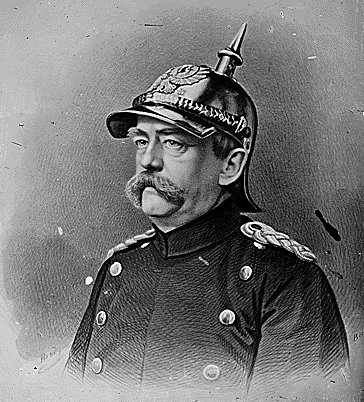 . Bismarck then continually ignored the Legislation from 1862 to 1866, building a bigger army and seeking a more active foreign policy as well as using his new form of politics called realpolitk, in which the ethical side of a problem is ignored in favor of the political connotations. Soon, Germany was accepted as an ally in the hopes that unification of the German state could begin. The first step towards Bismarck's goals was an attack on Denmark over the duchies of Schleswig and Holstein. Denmark soon joined Austria, and it quickly became a battle between both Austria and Prussia in an attempt at thwarting the unification of Germany. Prussia won on Feburary 1st, 1864. However, a deal was struck. Austria got Holstein, while Prussia got Schleswig. This didn't work out so well, as Austria wanted both duchies, and finally another war breaks out. Since Prussia has a more advanced industry and a better railroad system, they prepared for war much faster and at K�niggr�tz on July 3rd, 1866 Prussia defeats Austria. With this defeat the German states north of the Main River are left free, and they form the North German Confederation. Some of them are a bit reluctant, as this would mean close ties with a Protestant Prussia for many Catholic German states, but they sign anyways since Prussia seems less dangerous than France. France does not leave well enough alone though, as their ruler Napoleon III wants to keep the public attention on matters of diplomacy and not the current domestic problems of France. So, in 1870 Prussia and France go to war over a dispute as to whether or not a relative of the Prussian monarchy should be allowed to rule Spain. This is the beginning of the Franco-Prussian War. Prussia won again, with the aid of the North German Confederation, and at Sedan on September 2nd the French Army and their ruler are captured. Paris surrenders on January 28th, 1871, and the treaty is signed in May. France is forced to pay 5 billion francs, as well as hand over the area of Lorraine and Alsace. Soon after, southern German states join the North German Confederation, and on January 18, 1871 in the Hall of Mirrors at Versailles, William I of Prussia is declared Emporer of Germany and Prussia leaves France as the strongest country in Europe.
Home